

How is a flat bar identified?
By its solid rectangular cross-section and width × thickness designation. Include length when describing the quantity you need.
Flat steel bars for fabrication, manufacturing and structural components. We roll rectangular bars as material for fabricated brackets, straps and connecting pieces. Component drawings and finish requirements determine how our fabrication and galvanising processes are used.
Reference standard: IS 1732:1989.
Reference: IS 1732:1989.
Scroll table sideways to see all columns
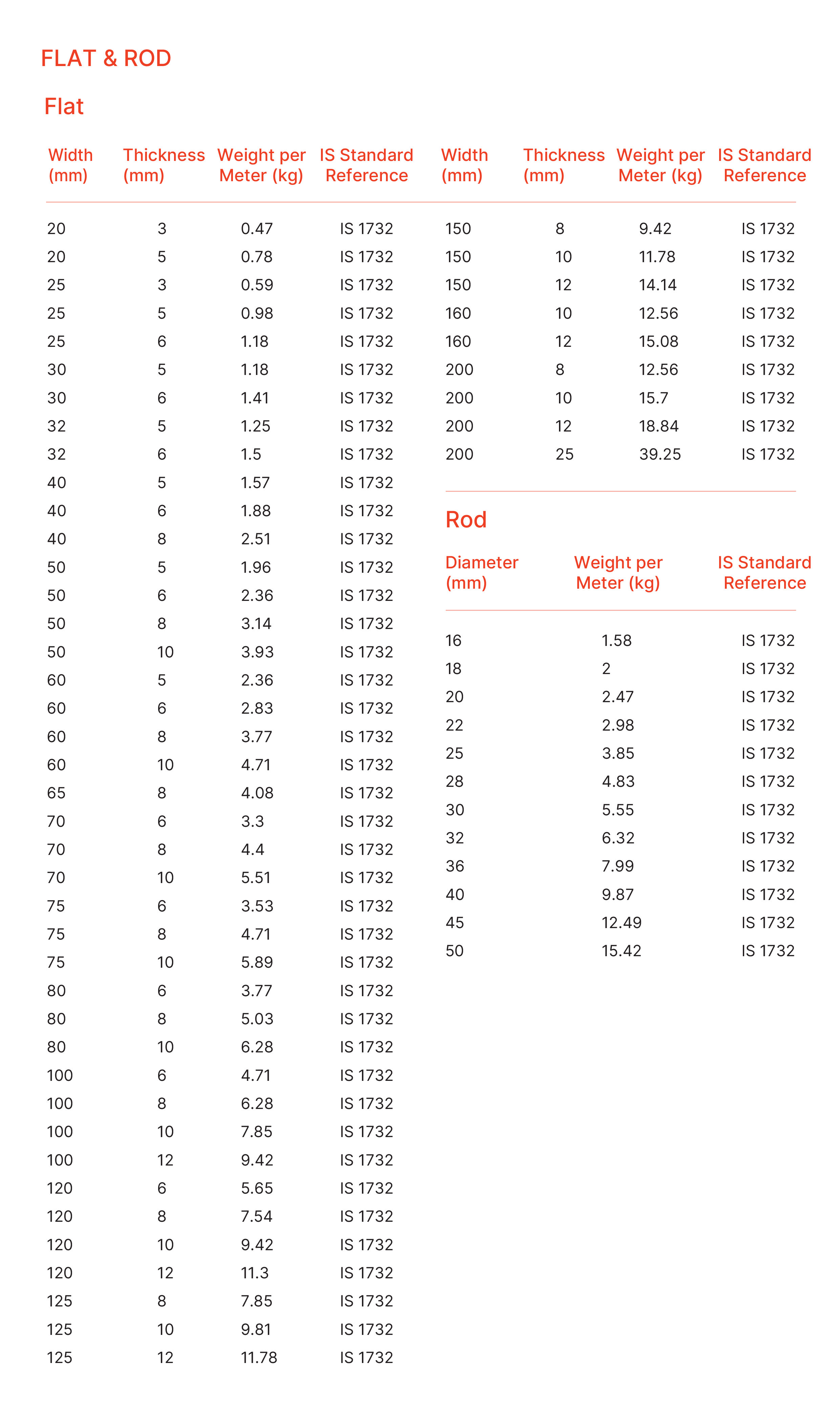
| Width (mm) | Thickness (mm) | Theoretical weight (kg/m) |
|---|---|---|
| 20 | 3 | 0.47 |
| 20 | 5 | 0.78 |
| 25 | 3 | 0.59 |
| 25 | 5 | 0.98 |
| 25 | 6 | 1.18 |
| 30 | 5 | 1.18 |
| 30 | 6 | 1.41 |
| 32 | 5 | 1.25 |
| 32 | 6 | 1.5 |
| 40 | 5 | 1.57 |
| 40 | 6 | 1.88 |
| 40 | 8 | 2.51 |
| 50 | 5 | 1.96 |
| 50 | 6 | 2.36 |
| 50 | 8 | 3.14 |
| 50 | 10 | 3.93 |
| 60 | 5 | 2.36 |
| 60 | 6 | 2.83 |
| 60 | 8 | 3.77 |
| 60 | 10 | 4.71 |
| 65 | 8 | 4.08 |
| 70 | 6 | 3.3 |
| 70 | 8 | 4.4 |
| 70 | 10 | 5.51 |
| 75 | 6 | 3.53 |
| 75 | 8 | 4.71 |
| 75 | 10 | 5.89 |
| 80 | 6 | 3.77 |
| 80 | 8 | 5.03 |
| 80 | 10 | 6.28 |
| 100 | 6 | 4.71 |
| 100 | 8 | 6.28 |
| 100 | 10 | 7.85 |
| 100 | 12 | 9.42 |
| 120 | 6 | 5.65 |
| 120 | 8 | 7.54 |
| 120 | 10 | 9.42 |
| 120 | 12 | 11.3 |
| 125 | 8 | 7.85 |
| 125 | 10 | 9.81 |
| 125 | 12 | 11.78 |
| 150 | 8 | 9.42 |
| 150 | 10 | 11.78 |
| 150 | 12 | 14.14 |
| 160 | 10 | 12.56 |
| 160 | 12 | 15.08 |
| 200 | 8 | 12.56 |
| 200 | 10 | 15.7 |
| 200 | 12 | 18.84 |
| 200 | 25 | 39.25 |
Weights are theoretical; actual dispatch weight may vary.
Product guide
A flat bar has a solid rectangular cross-section, described by width and thickness. Its broad flat faces are useful when arranging fabricated components, straps, brackets and connecting pieces.
We supply flat bars for manufacturing and fabrication requirements. Their rectangular form provides flat contact faces for parts assembled to a drawing. Dimensions, material specification and the intended connection determine the requirement; the shape alone is not a performance specification.
Share width, thickness, required lengths, quantity and the required grade or standard. Add the component drawing, finish, delivery location and date so our team can review the details.
Enquire about FlatsBy its solid rectangular cross-section and width × thickness designation. Include length when describing the quantity you need.
Weights are theoretical; actual dispatch weight may vary. Use the kg/m figures to understand the listed section, keeping the dispatch quantity distinct.
Yes. Send the proposed width, thickness and material requirements for technical confirmation. Include a drawing where the flat forms part of a fabricated component.